
Congratulations! VIPL's 4 papers are accepted by NeurIPS 2026. NeurIPS, officially known as Annual Conference on Neural Information Processing Systems, is a top-tier conference in the field of artificial intelligence. The conference will be held from December 6 to December 13, 2026, with the main venue in Sydney, Australia, and satellite venues in Atlanta, USA, and Paris, France.
The accepted papers are summarized as follows.
1. Geometric Prompt-Trajectory Planning for Test-Time Scaling (Zhengqi Pei, Anran Zhang, Qingming Huang, Shuhui Wang)
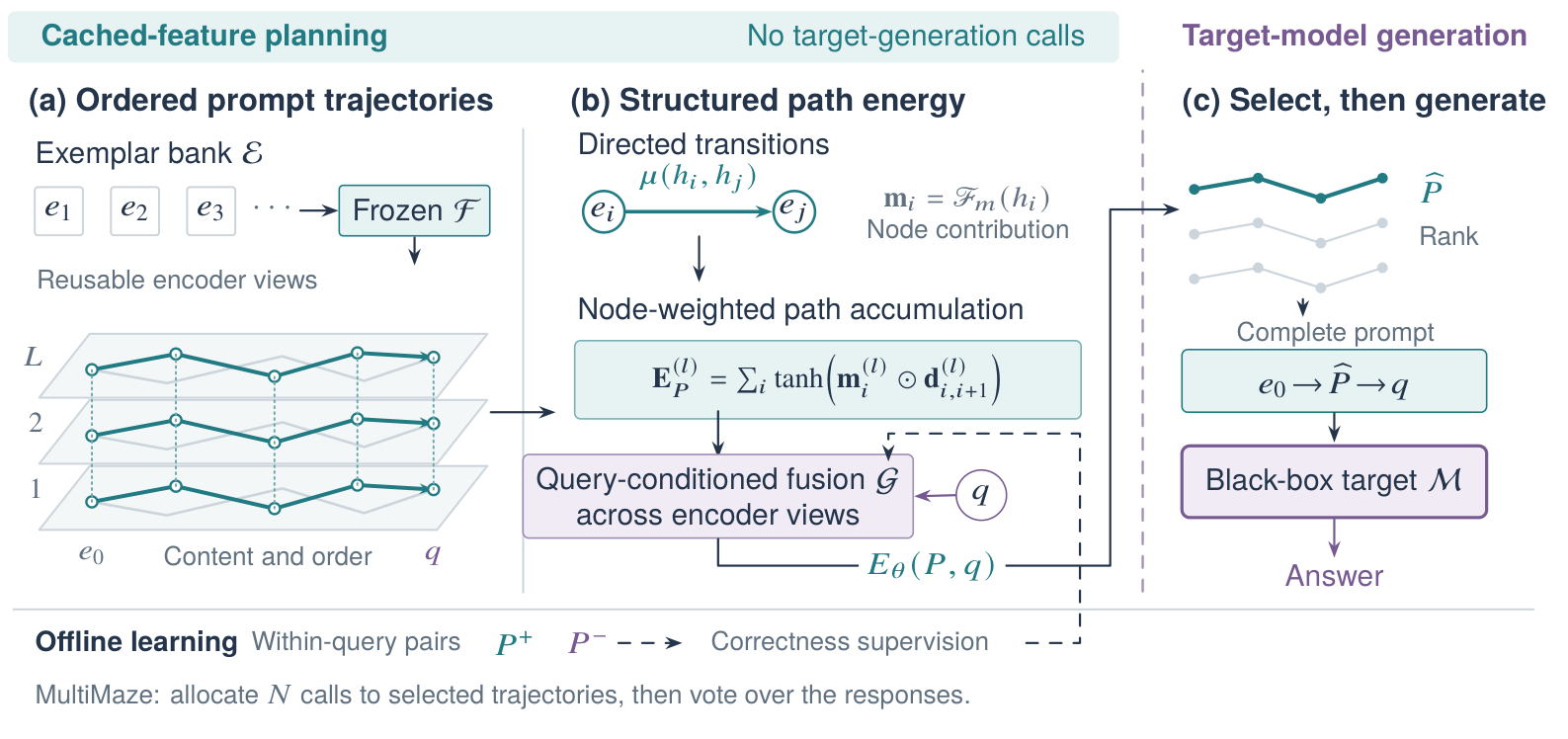
Test-time scaling (TTS) improves large language model (LLM) reasoning by allocating additional inference-time computation, often through repeated sampling and aggregation. This width-heavy strategy increases the generation cost and can reinforce common failure modes.We introduce \emph{Maze}, a TTS framework that shifts part of this computation from repeated target-model calls to planning over ordered few-shot exemplars.Maze treats an exemplar sequence as a prompt trajectory and ranks candidate trajectories using a lightweight geometric scorer over cached encoder representations.Directed transitions, node contributions, and query-conditioned cross-layer fusion model how the complete path guides the target model. The selected trajectory is executed with one call, or with a small call budget in MultiMaze. A separate frozen encoder preserves black-box access to the target LLM. Across five reasoning benchmarks, single-call Maze outperforms the evaluated single-call prompt-optimization baselines, while MultiMaze improves on 32-call majority vote using 16 target-model calls. Shared-pool comparisons isolate the benefit of prompt selection from answer aggregation. A theoretical analysis relates selection quality to candidate coverage and ranking error, explaining when planner-side computation can substitute for repeated sampling and when it cannot.
2. Component-Based Out-of-Distribution Detection (Wenrui Liu, Hong Chang, RuiBing Hou, Shiguang Shan)
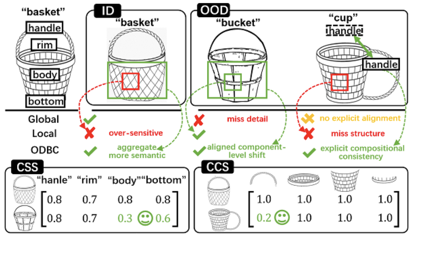
Out-of-Distribution (OOD) detection requires sensitivity to subtle distribution shifts while remaining robust to natural in-distribution variations. Existing global approaches may suppress localized OOD cues during feature aggregation, whereas patch-based methods are often vulnerable to noise, spurious correlations, and contextual interference. Moreover, both struggle with compositional OODs constructed from valid ID components. To address these challenges, we propose Component-Based OOD Detection (CoOD), a post-hoc framework inspired by Recognition-by-Components theory. CoOD decomposes inputs into semantically meaningful components and introduces two complementary scores: Component Shift Score (CSS), which captures fine-grained appearance shifts while suppressing patch-level noise, and Compositional Consistency Score (CCS), which measures semantic and geometric consistency among components to identify abnormal compositions. Extensive experiments demonstrate consistent improvements across coarse-grained, fine-grained, and compositional OOD detection.
3. Masked Diffusion Language Agents for Tool-Integrated Chemical Reasoning(Mengdi Liu, Chenghao Jia, Hong Chang, Shiguang Shan)
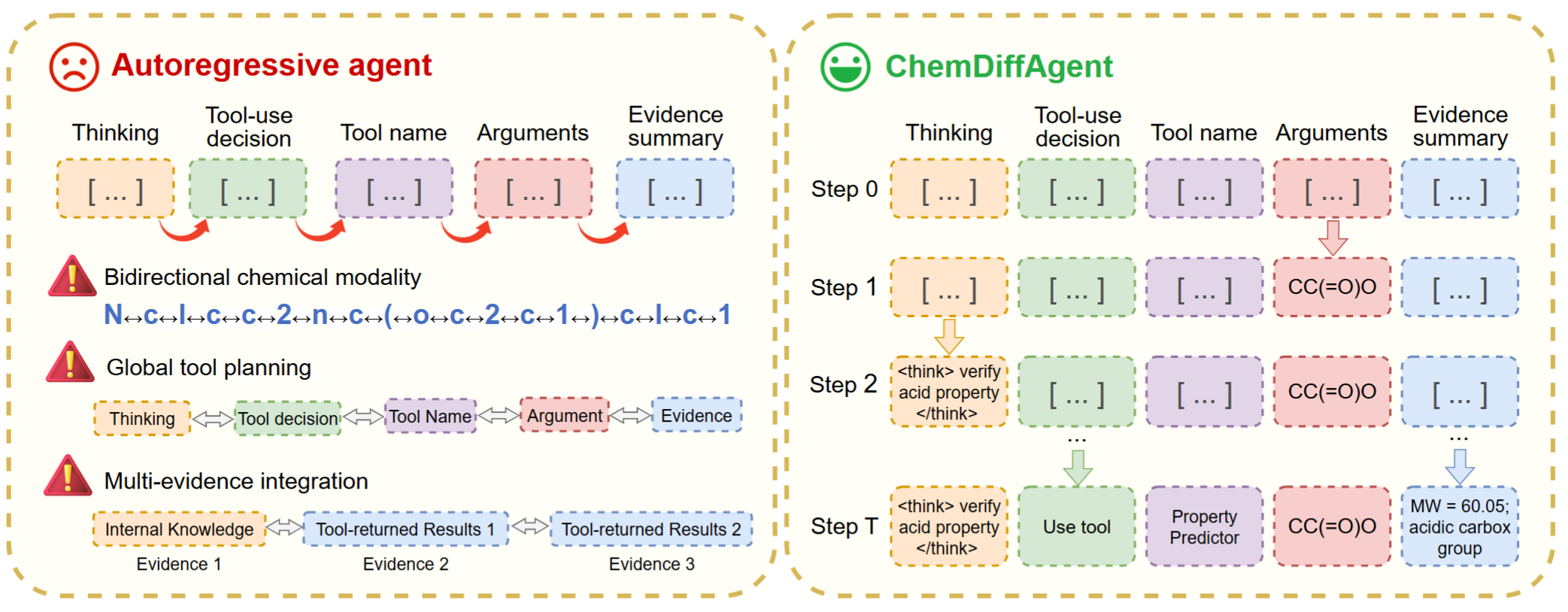
Designing tool-integrated reasoning agents for complex chemical tasks remains challenging. Current autoregressive (AR) agents are constrained by causal attention and left-to-right generation, limiting their bidirectional molecular understanding, global tool planning, and multi-source evidence integration. To address this, we introduce ChemDiffAgent, the first masked diffusion language agent for tool-integrated chemical reasoning. By reframing chemical reasoning as iterative denoising over interleaved reasoning and tool-use trajectories, ChemDiffAgent enables joint tool decisions under full-trajectory global context, thereby aligning its decision boundary with its knowledge boundary. We show that masked diffusion benefits agentic reasoning through challenging infilling training objectives and flexible, arbitrary-order decoding during inference. Furthermore, we develop a two-stage post-training framework combining agentic supervised fine-tuning and variance-reduced preference optimization. Across a comprehensive 6-task benchmark spanning single- and multi-turn scenarios, ChemDiffAgent outperforms AR baselines by ~20% under matched evaluation budgets, with our 8B model matching or surpassing frontier models like GPT-5.5 and Claude Opus 4.7.
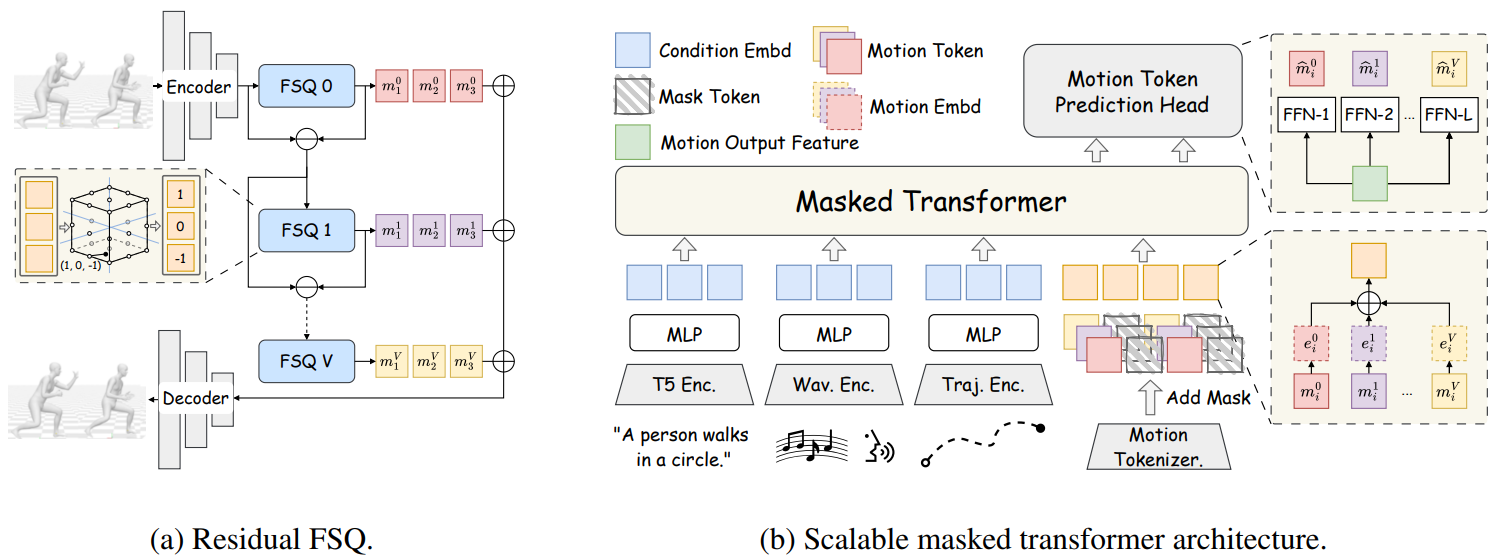
4. AnyMo: Scaling Any-Modality Conditional Motion Generation with Masked Modeling(Yiheng Li, Zhuo Li, Ruibing Hou, Yingjie Chen, Hong Chang, Hao Liu, Shiguang Shan)
Human motion generation aims to synthesize natural and coherent human movements from conditions such as text, speech, and music. However, existing methods are often limited to specific modalities and constrained by the scale and diversity of available multimodal motion data, making flexible multimodal generation challenging.
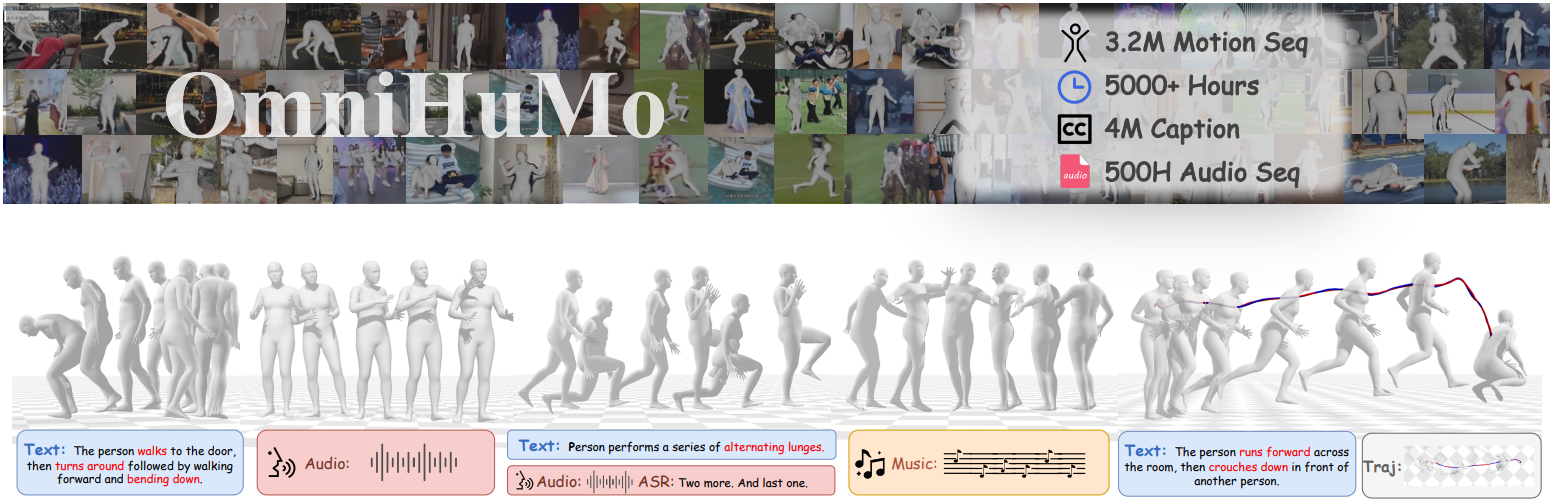
To address this issue, the paper introduces OmniHuMo, a large-scale multimodal human motion dataset with over 5,000 hours and 3.2 million motion sequences, and AnyMo, a unified framework for multimodal motion generation. AnyMo uses a Residual Finite Scalar Quantization (R-FSQ)-based motion representation and a masked Transformer to jointly model text, speech, music, and motion trajectories, enabling motion generation under arbitrary combinations of modalities. Experiments show that scaling up the training data and model size significantly improves generation performance, while additional modalities such as motion trajectories further enhance semantic consistency and spatial controllability. This work provides a scalable approach toward general-purpose multimodal human motion generation.
Download: