
Congratulations! VIPL's 3 paper are accepted by ACM MM (ACM International Conference on Multimedia) 2026! ACM MM is a top conference on multimedia. This year, ACM MM will be held in Rio de Janeiro, Brazilfrom November 10 to November 14.
The accepted papers are summarized as follows:
1. DishSeg24k: A Large-Scale Benchmark for Food Segmentation with Stochastic Expert Decoding (Yilin Wang, Haochen Shi, Guanyu Chen, Weiqing Min, Jinkai Zheng, Chenggang Yan, Shuqiang Jiang)
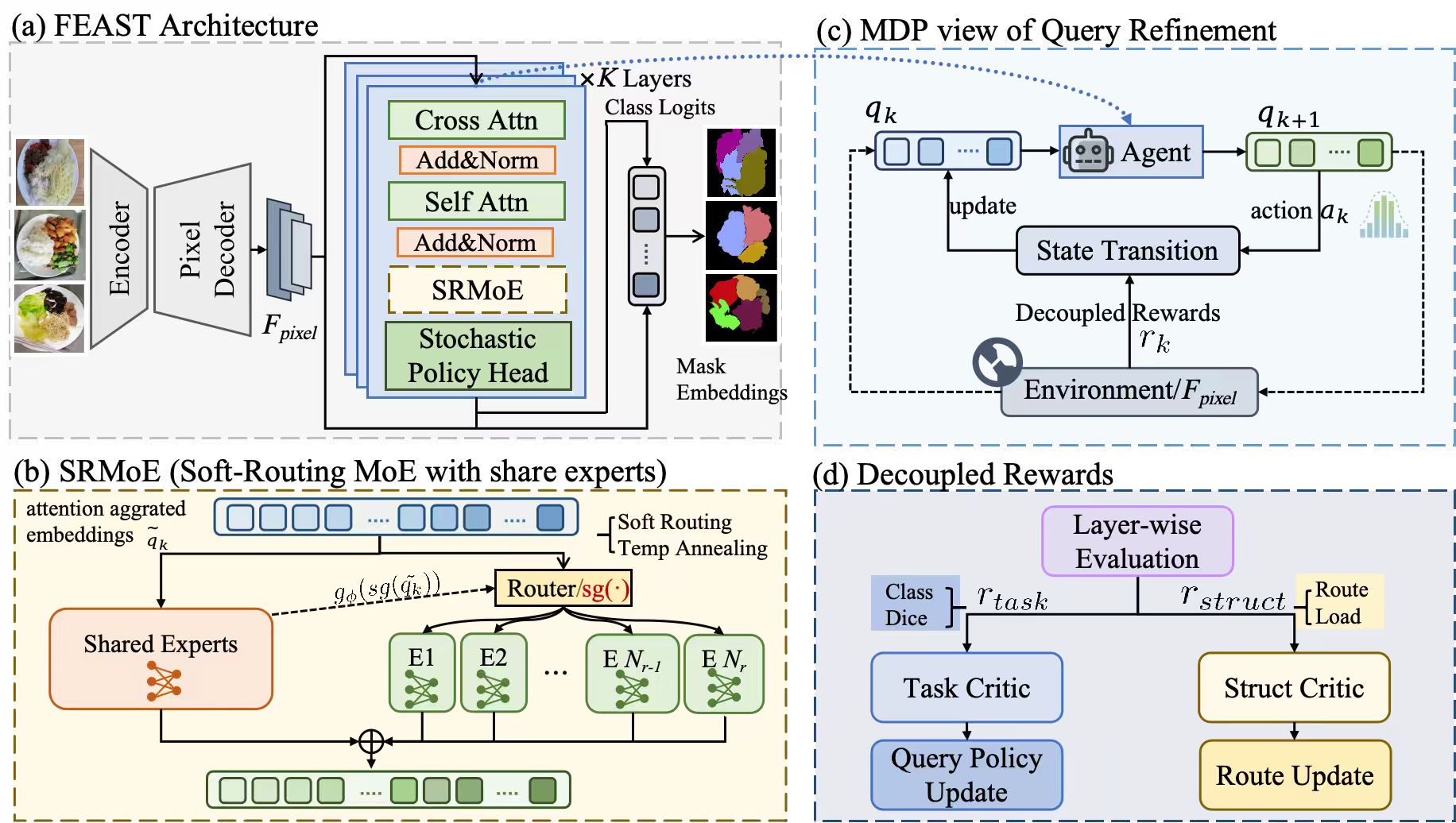
Food segmentation is essential for applications such as intelligent catering, dietary assessment, and recommendation. However, existing benchmarks fail to capture the complexity of real-world dining scenes. The challenges of dense inter-dish overlap, fine-grained class similarity, and extreme long-tail class distributions exceed the fidelity of current datasets. To fill this gap, we introduce DishSeg24k, a large-scale dish-level segmentation benchmark with 24,096 images, 112,281 instances, and 278 fine-grained categories in real-world dining environments. Based on DishSeg24k, we further propose Food Expert-Adaptive Segmentation Transformers (FEAST) to address these challenges. FEAST models query-based decoding as a Markov Decision Process (MDP), where each decoder layer update is treated as a sequential decision step that explores uncertainty along dish boundaries. We further redesign the decoder with a reinforcement learning (RL)-guided Mixture-of-Experts (MoE) module, in which a dual-critic decoupled optimization scheme separates task-oriented query refinement from structure-aware expert routing. This design promotes expert specialization and prevents expert collapse under long-tail category distributions. Finally, extensive experiments on DishSeg24k demonstrate the state-of-the-art performance of FEAST, which outperforms previous methods by +3.21% mIoU, +3.68% mDice, and +4.00% mAcc, respectively. We further validate the effectiveness of FEAST on FoodSeg103.
2. VOPE: Revisiting Hallucination of Vision-Language Models in Voluntary Imagination Task (Xingming Long, Jie Zhang, Shiguang Shan, Xilin Chen)
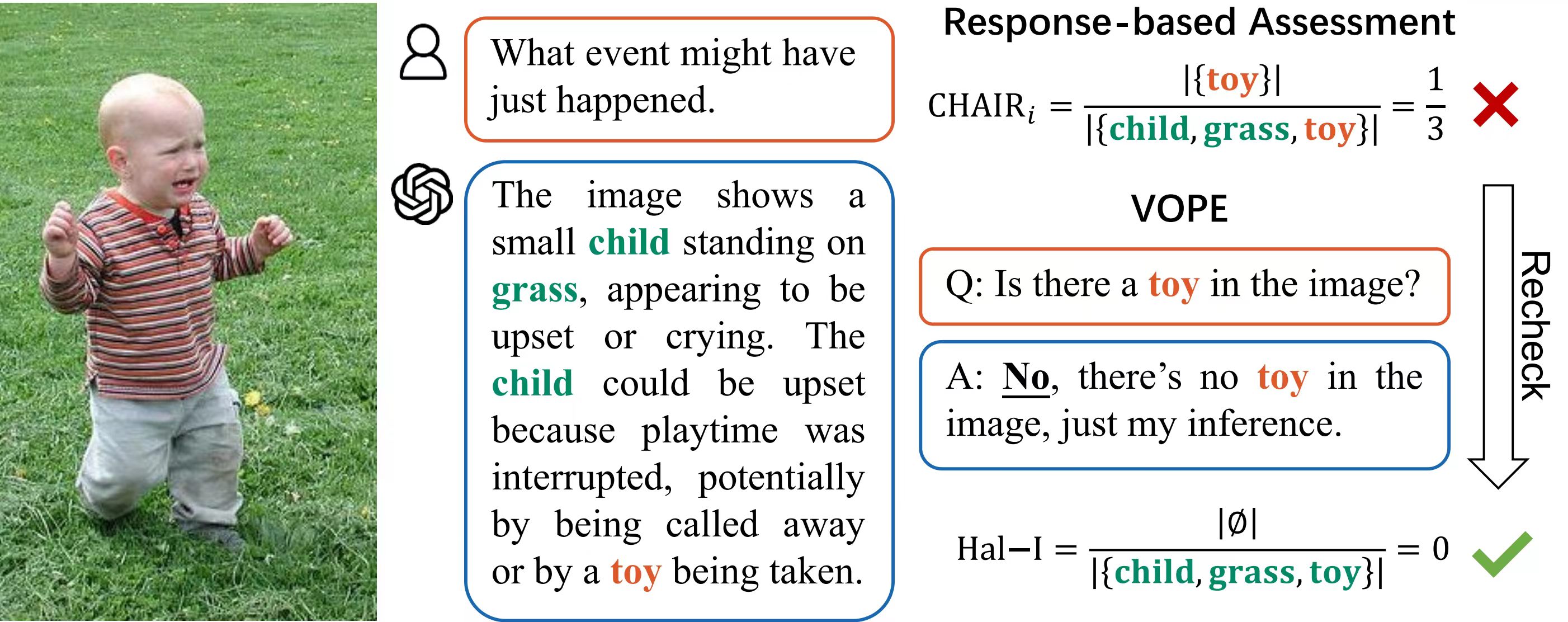
Most research on hallucinations in Large Vision-Language Models (LVLMs) focuses on factual description tasks that prohibit any output absent from the image. However, little attention has been paid to hallucinations in voluntary imagination tasks, such as story writing, despite this human-like cognitive ability being essential for real-world generative applications. To address this limitation, we introduce Voluntary-imagined Object Presence Evaluation (VOPE)---a recheck-based evaluation benchmark for assessing LVLMs' grounding behavior in voluntary imagination tasks. Specifically, VOPE poses recheck-based questions to evaluate how an LVLM interprets the presence of the imagined objects in its own response. Rather than penalizing the imagined content itself, VOPE identifies hallucinations based on the correctness of the model's presence judgments for the generated objects. Built on this idea, we construct a dataset covering captioning, reasoning, and writing tasks with different levels of voluntary imagination. We apply VOPE to several mainstream LVLMs and hallucination mitigation methods, revealing two key findings: (1) most LVLMs hallucinate heavily during voluntary imagination, and their performance in presence evaluation is notably poor on imagined objects; (2) existing hallucination mitigation methods show limited effect in voluntary imagination tasks, making this an important direction for future research.
Paper Link:https://arxiv.org/abs/2511.13420
3. When 1+1 Backfires: Rethinking Relevance-Diversity Balancing for Sample-Aware Visual Token Reduction (Yihang Huang, Peisong Wen, Chenhao Zhou, Difu Feng, Qianqian Xu)
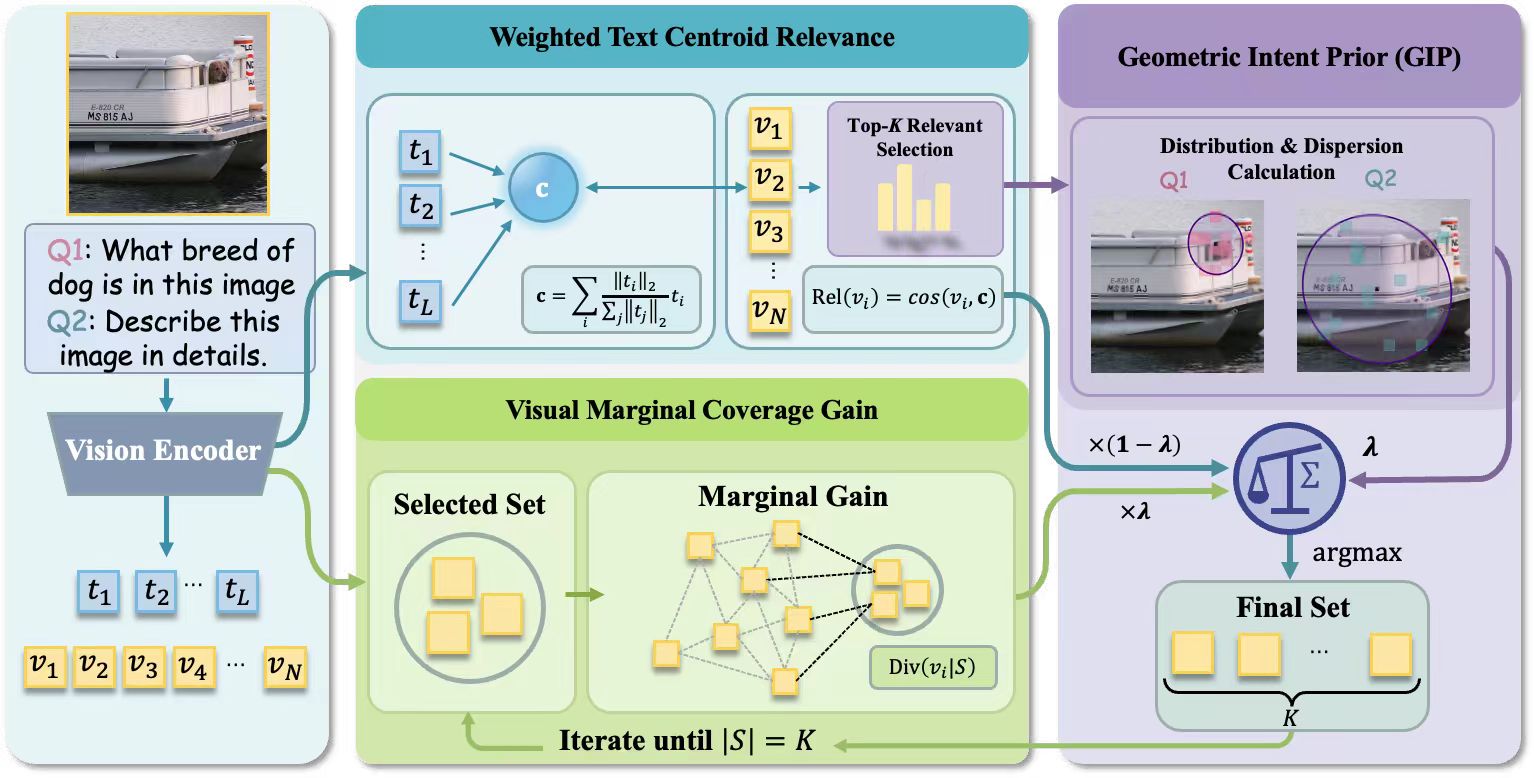
Visual token compression is an important technique for reducing the inference cost of Large Vision-Language Models (LVLMs). Existing methods typically select tokens according to text relevance or visual diversity, or combine the two using a fixed weighting strategy, implicitly assuming that all inputs require the same relevance-diversity balance. However, our systematic analysis reveals that the optimal balance varies substantially not only across tasks but also among individual samples within the same task. This finding suggests that simply combining relevance and diversity does not necessarily improve performance; instead, effective visual token compression requires the balance between them to be adjusted for each input. To this end, we propose SAVER, a training-free framework for sample-aware relevance-diversity balanced visual token reduction. SAVER derives a Geometric Intent Prior (GIP) from the spatial distribution of highly relevant visual tokens and uses it to estimate the desired relevance-diversity balance for each sample. During token selection, we further introduce a Weighted Text Centroid (WTC) to measure text relevance and a Visual Marginal Coverage Gain (VMCG) to evaluate the coverage of image content. The entire framework operates at inference time without additional training or auxiliary prediction modules. Experiments across multiple visual question answering and multimodal reasoning benchmarks, as well as different model architectures, validate the effectiveness of SAVER.
Download: